
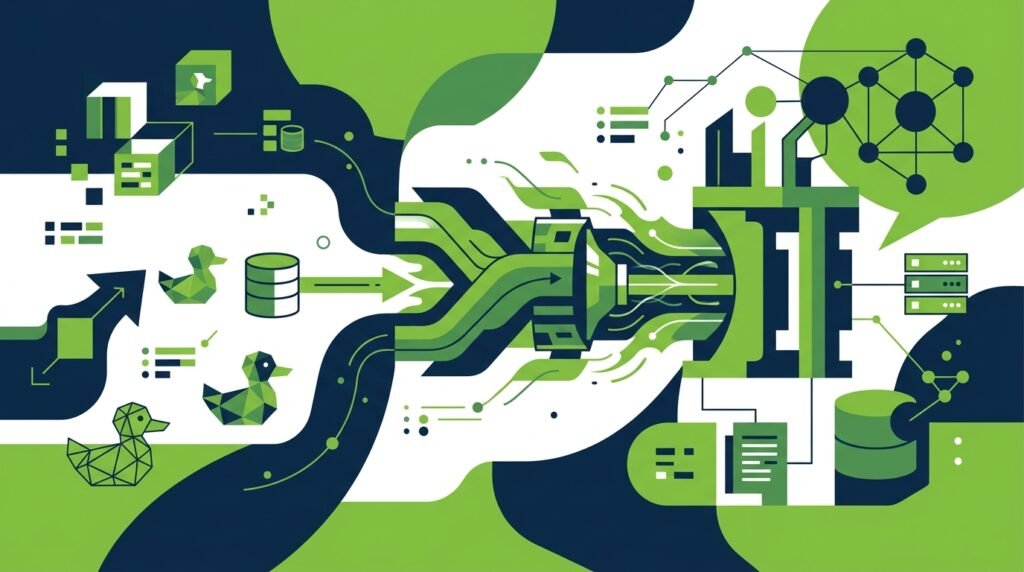
Amazon has announced the acquisition of DuckLabs, enabling Amazon Aurora PostgreSQL users to run unified queries across operational and historical datasets without deploying extra infrastructure.
Headquartered in Amsterdam, DuckLabs is the company responsible for developing the open-source analytical database engine DuckDB. Co-founders Hannes Mühleisen and Mark Raasveldt will remain at the helm of the team and guide the project’s technical roadmap within Amazon Web Services (AWS). According to their official blog announcement, joining AWS provides the resources and scale required to expand DuckDB to a broader range of organizations.
Open-Source Roadmap and Community Continuity
Both organizations affirmed that open-source developments will proceed uninterrupted. DuckDB along with companion components such as DuckLake and Quack will remain free and open source under the MIT license, with oversight continuing under the non-profit DuckDB Foundation. The wider community welcomed the move, accompanied by some skepticism regarding whether the pace of independent innovation will remain intact inside AWS.
Andy Warfield, distinguished engineer at AWS, noted that engineering collaboration with DuckLabs started roughly two years ago during the development of S3 Tables. That joint work included testing AWS Lambda for ultra-fast query execution and optimizing commands like ATTACH and CONNECT to link DuckDB smoothly with AWS services.
Direct Integration Within Amazon Aurora PostgreSQL
Following the deal, Amazon Aurora PostgreSQL becomes the first AWS service to launch a user-facing integration powered by DuckDB. Esra Kayabali, principal solutions architect at AWS, pointed out that organizations previously had to construct reverse ETL pipelines to join live transactional data in Aurora with historical records in Amazon S3, resulting in duplicated data and increased cloud hosting expenses.
The newly launched feature allows developers to execute a single query that joins:
- Live transactional data residing in Aurora.
- Historical datasets stored in Apache Iceberg tables cataloged by AWS Glue Data Catalog.
- Files in Parquet and Iceberg formats stored across Amazon S3 and S3 Tables.
Processing happens entirely inside Aurora without intermediate ETL tasks or extra network hops. The feature is available across all commercial AWS regions and AWS GovCloud (US) at no additional charge beyond standard incremental Aurora compute and regular Amazon S3 requests.
Optimized for Sub-Terabyte Queries and AI Workloads
Mai-Lan Tomsen Bukovec, vice president of technology at AWS, emphasized that DuckDB was engineered specifically for rapid analytical querying on datasets of one terabyte or smaller. She added that this architecture is particularly advantageous for artificial intelligence agents, which routinely run lightweight exploratory queries against backend databases before determining their subsequent actions.
Potential Impacts of Future Policy Decisions
From an institutional perspective, the acquisition of a European entity based in the Netherlands by a major US cloud provider brings considerations regarding digital sovereignty and antitrust oversight into view. While governance of the open-source core remains under the DuckDB Foundation, potential policy decisions concerning technology consolidation, cross-border data transfer frameworks between the European Union and the United States, or public sector procurement mandates could influence long-term deployment strategies across regulated cloud environments.
What this means for your business
For small and mid-sized businesses, this development allows operational day-to-day data and historical cloud archives to be queried together without building or managing costly ETL synchronization pipelines. By processing analytics directly inside the database, companies can lower server bills, extract business insights faster, and prepare their data infrastructure for automated AI agent workflows.
Source: InfoQ · October 17, 2026
Text and illustration prepared with AI assistance and reviewed by the AFC IT Solutions team.